Agentic AI: AI That Does, Not Just Says
By: Roger Creasy
Most people's experience with AI is conversational. You ask a question, you get an answer. Maybe you ask it to write something, and it writes it. The exchange ends there.
Agentic AI is different. It doesn't just respond — it acts.
The word "agentic" comes from "agent" — something that takes action on your behalf. An agentic AI system can be given a goal, and then pursue that goal across multiple steps, making decisions along the way, using tools, and adapting when things don't go as planned.
Think about the difference between asking someone "How do I send a report to my team?" and handing that same person your laptop and saying "Send the report to my team." The first is a conversation. The second is delegation.
What Makes AI "Agentic"?
A few things separate agentic AI from the chat-based AI most of us have used:
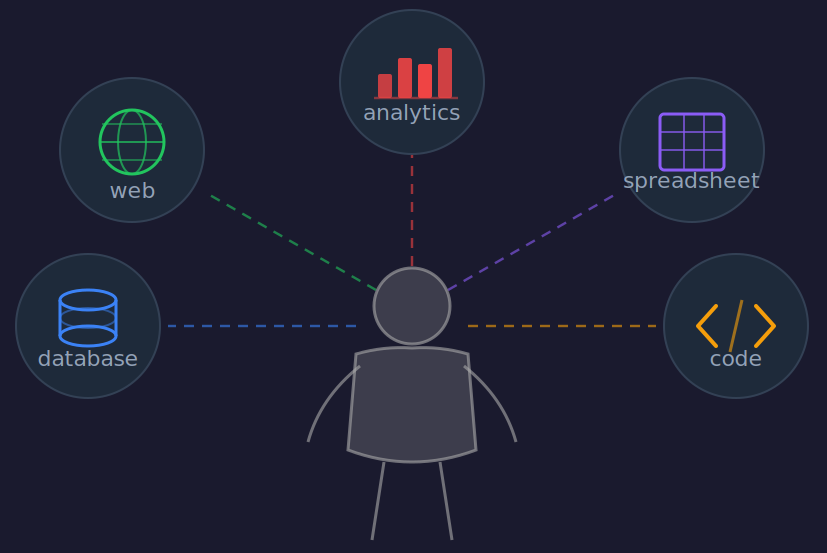
Tool use. An agentic system can call external tools — APIs, search engines, databases, code executors. It isn't limited to what it already knows; it can go get what it needs.
Multi-step reasoning. Rather than answering in one shot, it breaks a goal into steps, executes them in sequence, and checks its own progress.
Decision-making. When it hits a branch point — a choice to make — it evaluates options and picks one. Sometimes it asks for clarification. Sometimes it just proceeds.
Memory. More advanced agentic systems can remember context across a session, or even across sessions, so they aren't starting from zero every time.
A Practical Example
Let's say you ask an agentic AI to "research our top three competitors and summarize their pricing pages."
A conversational AI will tell you it can't browse the web, or give you what it knows from training data, which may be months out of date.
An agentic AI will search the web, navigate to each competitor's pricing page, extract the relevant information, and hand you a summary — all without you managing each step.
That's a meaningful difference.
What to Watch Out For
Agentic AI introduces new considerations.
When AI is taking actions — sending emails, modifying files, making API calls — mistakes have real consequences. A hallucination in a chat is annoying. A hallucination that drives an automated action is a problem.
This is why the best agentic systems are designed with human checkpoints. The AI can plan and propose; a human approves before anything irreversible happens. At least until you trust the system enough to let it run.
The other consideration is scope. Giving an AI broad access to your systems to act on your behalf requires the same kind of trust calculus as giving that access to a human. You wouldn't hand a new employee the keys to everything on day one.
Where This is Heading
Right now, most agentic AI is used by developers and technical teams — building workflows, automating research, writing and running code. But the tools are becoming more accessible, and the use cases are expanding fast.
In practical terms: if you have repetitive, multi-step processes in your work, agentic AI is worth understanding. Not because you should automate everything, but because knowing what's possible helps you make better decisions about what's worth your time.
The goal isn't AI that replaces judgment. It's AI that handles the steps that don't require it, so your judgment gets applied where it matters.
Have you started experimenting with agentic AI tools? I'd like to hear what's working — and what isn't.